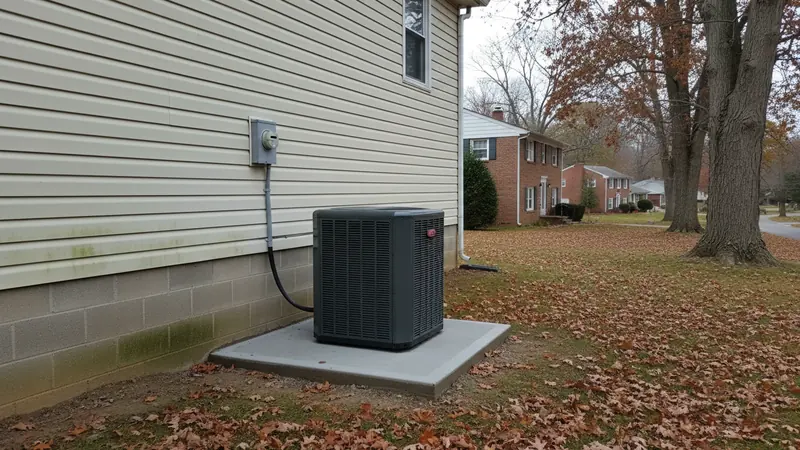
Before you compare installation quotes, check which fuel your system will use. Look at the ducts you already have. Check Howard County's permit requirements too.
What you are replacing changes the permit decision
You need a Howard County HVAC permit for a new residential system. You also need one to switch fuel or energy source. That includes switching from oil to a heat pump or from gas to electricity. The permit policy also covers additions, alterations and duct extensions.
You do not need a permit for an exact replacement of existing electrical HVAC equipment. A gas furnace or oil burner does not qualify just because you keep the same fuel. Before work starts, ask your contractor which work needs a permit.
You normally do not need a permit to replace a geothermal system. If you want a tax credit, you need a permit. You need Manual J calculations for that too.
Source: Howard County DILP, HVAC Permit Policy, dated 14 May 2024 (S2 in the research register). Gathered 2026-09-20.
Size the system and account for the ducts
The county requires Manual J, Eighth Edition, to calculate the load. If you alter the system but reuse existing ducts, you can submit a letter instead of full Manual J sheets. The master licence holder must sign it. The letter must confirm that your existing system can carry the added load.
Ask for sizing paperwork as part of the installation. If you are finishing a basement, ask for any duct extensions to be listed in your quote. Those need a permit even if the equipment stays in place.
Source: DILP HVAC Permit Policy (S2). Gathered 2026-09-20.
Budget for the permit separately from the equipment
For a single-family home, the FY27 schedule lists a $50 application fee. You also pay $40 per heating/cooling zone. There is a 10% technology fee too. These county charges do not cover equipment or installation.
The schedule does not make clear which fees that percentage applies to. For a single-zone job, applying it to both the application and zone fees gives $99. Applying it only to the zone fee gives $94. We could not settle which calculation DILP uses. Ask for the confirmed charge in your quote.
The schedule also lists $100 for starting work without a permit. If your quote includes a permit allowance, settle who applies. Agree when they will apply too.
Source: DILP FY27 HVAC Permit Fee Schedule, Council Resolution #83-2026, effective 1 July 2026 (S1). Gathered 2026-09-20; refresh when the FY28 schedule is adopted, expected around July 2027.
Allow for approval before setting the work date
The county's published records show a six-day median from applying to getting a permit. That covers 1,033 residential HVAC alteration permits filed between 1 January and 27 October 2025. 69% were issued within seven days. Those past processing times do not promise you an installation date.
The records we used contain only issued permits. The latest issue date is 26 November 2025. We stopped the filing window a month earlier to reduce the bias from missing slow permits near that cutoff. Pending applications are missing. These figures cannot guarantee how long you will wait. They leave out the time your contractor needs to prepare. They also leave out the time needed to arrange inspections later.
Source: Howard County open-data permit extract, updated 4 December 2025 (S19). Gathered 2026-09-20; the next annual refresh is expected in December.
Include inspections in the handover
For residential mechanical work, the county lists inspection code 603 — Rough In. It also lists 600 — Final. Electrical or plumbing work may need separate inspections. Before installation, settle who books each required inspection. Agree who gives you the results too.
The county publishes a checklist. Ask your installer to read it. It governs where the equipment can sit. A heat pump must sit at least six inches above grade. The electrical disconnect must be within sight of the unit. Attic equipment needs a 36-inch service walkway. It needs a light too. It also needs a receptacle.
Sources: DILP inspection scheduling brochure, revised 14 April 2025 (S3), and Inspection Requirements (S5). Gathered 2026-09-20.
Gathered 2026-09-20. We have a source for every figure. We could not find installed prices.