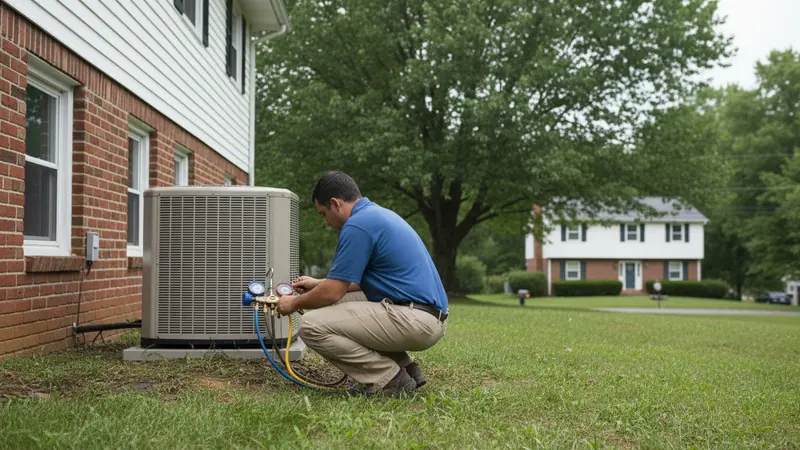
Permits, inspections, what the county actually charges, and what tends to be wrong with the heating and cooling in a Howard County house.
You can see when we gathered each figure. We have included any known expiry dates too.
Do you actually need a permit?
The answer is less obvious in Howard County than you might expect.
Howard County has a separate residential HVAC permit. It comes from a Cooperative Agreement between the Maryland State Board of Heating, Ventilation, Air-Conditioning and Refrigeration Contractors and Howard County. The agreement was made under section 9A-205 of the Business Regulation Article of the Maryland Code.
Under that agreement, the County must run permits and inspections for residential central heating and cooling systems. The process checks that licensed contractors install them. It also checks that the work meets the applicable codes.
That tells you what the permit is for. It is not there to raise revenue. Nor is it paperwork for its own sake. It is how the state checks that whoever worked on your furnace was allowed to.
You need an HVAC permit for:
- Installing any HVAC system in a new home.
- Converting equipment to a different fuel or energy source — oil to gas, gas to a heat pump, propane to electric.
- Replacing existing equipment with something that uses a different fuel or power source.
- Adding to or altering your home where you need a new system or changes to the existing one.
- Extending ducts — including for a finished basement, an addition or a remodel. This has been the rule since 25 January 2021. It catches people out. You need a permit to extend ductwork into a basement you are finishing.
You do not need an HVAC permit for:
- "Exact replacement of existing electrical HVAC equipment." That is the County's own wording, from its permit policy. You are exempt under that written policy if you swap a heat pump or electric air handler for the same thing.
- Relocating an existing supply register without adding any new supply branches.
- Replacing a geothermal system — unless you are claiming a tax credit. To claim one, you need a permit. You also need Manual J calculations.
That first exemption matters more here than almost anywhere nearby. About half of Howard County's occupied homes heat with electricity. For many homes here, you need no HVAC permit for a like-for-like replacement.
Check for your own job. Those are the exact words in the County's
HVAC Permit Policy dated 14 May 2024. If your replacement is
anything other than strictly like-for-like electric, call DILP on
410-313-2455, option 4 before the work starts. If you start work
without a permit, the extra fee is $100. You still pay for the permit itself.
Source: Howard County DILP, HVAC Permit Policy, 14 May 2024. Gathered 2026-09-20.
What the permit costs
Howard County sets its HVAC fees through County Council Resolution #83-2026. They took effect 1 July 2026. The County adopts fees each fiscal year. The FY27 schedule is current.
| Item | Fee |
|---|---|
| Application fee (non-refundable, payable when you apply) | $50 |
| Single-family attached or detached dwelling, per heating/cooling zone | $40 |
| Multi-family / condo / apartment, per dwelling unit | $80 |
| Hotel or motel, per room | $80 |
| Technology fee | 10% on all HVAC permits |
| Revision or amendment (after the first, or any change once approved) | $50 |
| Extension of an application or permit | $50 per 90 days, one year maximum |
| Reinspection — 2nd failure of the same inspection | $100 |
| Reinspection — 3rd failure | $125 |
| Reinspection — 4th or more | $175 |
| Inspection outside business hours | $125 first hour, $100 each hour after |
| Work commenced without a permit | $100 |
A typical single-zone system replacement costs $50 + $40 = $90 in base fees. Add the 10% technology fee for a total of about $99. A two-zone house costs $130 before that fee. The total is about $143. A three-zone house costs about $187.
You pay per zone, not per unit or appliance. A house with two thermostats and two air handlers pays twice. Reinspection fees go up with each failure. If your contractor fails the same inspection three times, that adds $225 to your job. Ask about that before you sign.
We could not settle this one. The schedule says a 10%
technology fee "will be collected on all HVAC permits". It does not say
what the 10% applies to. Is it just the permit fee? Or does it include the
$50 application fee? We have assumed it includes both. That gives you the
higher estimate. On a single-zone job the difference is $5.
You can check with DILP on 410-313-2455, option 4.
Source: Howard County DILP, "FY27 HVAC Permit Fee Schedule", Council Resolution #83-2026, effective 2026-07-01. Gathered 2026-09-20. Superseded when the FY28 schedule is adopted, expected around July 2027.
How long the permit actually takes
Howard County publishes every permit it issues. Each record gives the application date and issue date. We counted the days between them rather than estimating. We made one correction, explained below the table.
Across 1,033 residential HVAC alteration permits filed between 1 January and 27 October 2025:
The numbers behind this
| Days from application to issue | |
|---|---|
| Median | 6 days |
| Issued same day | 7% |
| Issued within 7 days | 69% |
| Issued within 14 days | 90% |
| Issued within 30 days | 96% |
Counted, not estimated: Howard County open data, permits dataset kvz2-j5cj, 1,033 residential HVAC alteration permits filed 1 January – 27 October 2025. Gathered 2026-09-20. The median, 6 days, is a different kind of number and is left to the table.
Between January and November 2025, the County received 1,144 residential HVAC alteration applications. It received a further 398 for new construction.
It is slower in summer. Applications peaked in July at 169. March had the fewest, at 52. Homeowners replace air conditioning when it fails. It fails in the heat. The queue shows it. Permits filed in August took 10 days at the median. That compares with 4 days in March. If your system is limping along, you may be able to choose when to replace it. Late winter is faster. You also face less competition for your contractor's time.
Where the work was in 2025: Ellicott City (328 permits), Columbia (322), Elkridge (99), Laurel (85), Clarksville (62), Fulton (42), Woodbine (32), Highland (23).
What the timing covers. We measured the County's time from receiving
an application to issuing the permit. Your contractor needs time to prepare
the application too. You also need to allow time to schedule the inspection afterwards.
Why we stopped at 27 October. A permit only appears in the County's
extract once it has been issued. The latest issue date in this extract is
26 November 2025. A mid-November application that took six weeks would
therefore be missing. One filed that same day but issued in three would be
included. The longer an application took, the more likely it was to be missing.
You can see the problem in November's 95 alteration permits. **Not one took
longer than 14 days**. Every other month of 2025 had longer waits.
Those months' longest waits ranged from 29 days to 224.
Including the late applications would make November look faster than it was.
We would be measuring where the records stopped.
We therefore stopped at 27 October. That gave every application a full
30 days to be issued before 26 November. Each row in the table could then
fairly count permits that met or missed its deadline.
Use the whole January–November period instead, and the median falls to 5 days.
You get 70% inside a week. You get 97% inside 30.
Those figures look better because records are missing. They do not show
the County working faster. We have used the slower, honest figures.
For the same reason, November's 95 filings understate the month.
Treat the annual totals below as a minimum, not a full count.
Source: Howard County open data, "Building, Electrical, Fire, Grading, Mechanical, Plumbing & Sign Permits" (dataset kvz2-j5cj), extract last updated 2025-12-04, containing no permit issued after 2025-11-26. Issue-time figures cover filings of 1 January – 27 October 2025; volume and seasonality figures cover January–November 2025. Gathered 2026-09-20. The dataset is republished annually in December; 2026 filings are not yet published.
The inspections
Howard County runs exactly two mechanical inspections. You can book them using these codes:
- 603 — Rough In
- 600 — Final
That is the whole mechanical sequence for residential work. You may also need electrical or plumbing inspections. Those have separate codes. They have a separate queue too.
Scheduling. Once you have the permit, you can request an inspection for the next working day, or up to seven working days ahead:
- Phone: 410-313-3800, automated, 24 hours.
- Text: send
S <permit number> <code> <mm/dd>to 888-297-9841. SoS M25001234 600 03/14books a final inspection for 14 March.Ccancels.RESCHreschedules.Rreturns the result. - Mechanical/HVAC inspections office: 410-313-1840.
- For a two-hour arrival window, call 410-313-1823 between 7:30 and 8:30 a.m. on the morning of the inspection. Most people do not know about this number. It can mean losing a morning rather than a whole day.
You can get the results on inspection day. Use the same phone number or the County's Citizen Access portal.
Offices. Permits: 3430 Court House Drive, Ellicott City, MD 21043. Inspection scheduling: 7125 Riverwood Drive, Suite D2, Columbia, MD 21046.
Source: Howard County DILP, "Automated Inspection Request and Permit Information System", revised 14 April 2025. Gathered 2026-09-20.
What the inspector is actually going to check
Howard County publishes its inspectors' checklist. Most of it is for your contractor. But you can check a dozen items yourself just by looking around. These are also the items that most often fail.
Outside:
- Your heat pump must sit at least 6 inches above grade. It fails if it sits directly on the ground or on a pad that has settled. In practice, it also ices up. It rots out early too.
- Your condenser must be level. It must sit above grade. Its slab must support the whole footprint.
- The electrical disconnect must be within sight of the unit.
- Your unit must be far enough from any flue or exhaust outlet to avoid damage.
Ductwork:
- Supply run-outs must be airtight. Each joint needs three equally spaced screws.
- Trunk lines need support every 10 feet.
- Flexible, non-insulated air connectors must be under 14 feet.
- In unconditioned space, supply ducts need R8 insulation. Everything else needs R6. The insulation must be vapour-tight. It must cover the boots too.
- Returns cannot draw air from more than one floor through the same joist or wall cavity.
Attic and closet units — common in Howard County's 1980s and 1990s two-storey homes:
- Equipment over finished space needs a drain pan at least 1½ inches deep. The pan must be at least 3 inches larger than the unit in both width and length.
- The primary condensate drain must slope ¼ inch per foot. It needs a trap where required. You also need a secondary drain independent of the primary, or a float switch wired into the low-voltage circuit.
- You need a service walkway plank of at least 36 inches on the unit's service side. You also need a light, a receptacle and an accessible switch.
- Copper line sets through floors must be insulated. They also need nail plates for protection.
Controls:
- Your thermostat belongs on an interior wall, close to a return. It must be level. Draughts must be blocked from reaching it.
At the final inspection, the inspector sets the thermostat. They check for positive airflow at every supply register. They check for negative airflow at every return grille. Keep the manufacturer's equipment specifications on site.
Source: Howard County DILP, Inspection Requirements, HVAC Systems section. Gathered 2026-09-20.
- 1A heat pump must sit at least 6 inches above grade, level, on a slab carrying its whole footprint, with the electrical disconnect within sight of it. Set on the ground or on a pad that has settled, it fails — and in practice it also ices up and rots out early.
- 2Supply run-outs airtight with three screws equally spaced at every joint. Trunk lines supported every 10 feet. In unconditioned space, supplies insulated to R8 and everything else to R6, vapour-tight, with the insulation carried over the boots.
- 3Returns cannot be drawn from more than one floor through the same joist or wall cavity — which is a common finding in the county's 1980s and 1990s two-storey stock.
- 4Wherever equipment sits over finished space: a drain pan at least 1½ inches deep and 3 inches larger than the unit in both directions, the primary condensate drain sloped ¼ inch per foot, and a secondary drain independent of the primary or a float switch wired into the low-voltage circuit.
- 5The thermostat goes on an interior wall, close to a return, level and draft-stopped. At final inspection the inspector sets it and checks for positive airflow at every supply register and negative airflow at every return grille.
Howard County DILP, Inspection Requirements, HVAC Systems section. Gathered 2026-09-20.
Who is allowed to do the work
Maryland licenses HVACR contractors at the state level through the Maryland Board of HVACR Contractors. Here is what each licence takes:
- Journeyman — four years as a licensed apprentice. At least 6,000 hours of training under a licensed contractor. A 70% exam pass.
- Limited — a journeyman licence, followed by two years under a master. 1,000 hours in the year before applying. A 70% exam pass.
- Master — a journeyman licence, followed by three years under a master. 1,875 hours in the year before applying. A 70% exam pass. Masters who contract work must carry insurance.
Your paperwork must show the master's licence number. For a new system, check the drawings for the licensee's printed name, signature and Maryland HVAC licence registration number.
Are you altering a system using existing ductwork? You need a verification letter signed by the master licence holder. It must include their licence number. It must confirm that the existing system can carry the added load. You can use signed Manual J calculation sheets instead.
Howard County does not require its own contractor licence. Anne Arundel and Prince George's Counties require a county HVACR licence on top of the Maryland one. Howard does not. Here, your contractor needs the Maryland licence. Your job must also meet the County's permit and inspection requirements.
Sources: Maryland Department of Labor, Board of HVACR Contractors — licensing requirements and county licence pages; Howard County HVAC Permit Policy. Gathered 2026-09-20.
Which code your job is held to
Howard County has been on the 2024 International Code family since 7 September 2025, adopted by Council Bill 24-2025:
- 2024 International Residential Code, with Howard County amendments
- 2024 International Mechanical Code, with Howard County amendments
- 2024 International Energy Conservation Code, with Howard County amendments
- 2024 International Building Code, with Howard County amendments
- 2024 National Fuel Gas Code (NFPA 54) and 2024 International Plumbing Code, by Council Bill 26-2025
- 2023 National Electrical Code, since 3 June 2024
For your heating and cooling job, the main rules are in the Mechanical Code and the Energy Conservation Code. The energy code sets the duct insulation values. It also governs how you calculate the equipment size. The County currently uses Manual J, Eighth Edition for that calculation.
The Howard County amendments matter. Maryland law (Public Safety Article section 12-504) lets counties amend the state standards. They cannot weaken the energy conservation, fire sprinkler or wind provisions. Howard County uses that power. Your job in Ellicott City faces different rules from the same job across the Potomac.
Sources: Howard County DILP, Adopted Codes; Md. Code, Public Safety sections 12-503 and 12-504. Gathered 2026-09-20.
What Howard County houses are, and what goes wrong in them
Howard County has 126,789 housing units. More were built in the 1980s than in any other period listed: 27,137 homes. That is 21% of everything in the county. About 26% of the county's housing predates 1980.
The numbers behind this
| Built | Homes |
|---|---|
| 2020 or later | 3,648 |
| 2010–2019 | 18,101 |
| 2000–2009 | 20,900 |
| 1990–1999 | 24,565 |
| 1980–1989 | 27,137 |
| 1970–1979 | 17,359 |
| 1960–1969 | 8,802 |
| 1950–1959 | 3,686 |
| 1940–1949 | 167 |
| 1939 or earlier | 2,424 |
US Census Bureau, American Community Survey 2024 1-year estimates, table B25034. Gathered 2026-09-20.
The fuel those homes use shapes the HVAC work here:
The numbers behind this
| Heating fuel | Howard County occupied homes | Share |
|---|---|---|
| Electricity | 61,535 | 50% |
| Utility gas | 51,622 | 42% |
| Bottled gas / propane | 4,184 | 3% |
| Fuel oil / kerosene | 3,897 | 3% |
| Solar, wood, other | about 1,500 | 1% |
US Census Bureau, American Community Survey 2024 1-year estimates, table B25040, of 122,807 occupied homes. Gathered 2026-09-20. The electricity and gas counts carry margins of error of ±2,988 and ±2,949 — wide enough to matter for the exact percentages, not wide enough to disturb which one leads.
(The fuel figures cover 122,807 occupied homes. The 126,789 figure counts all housing units, including empty ones. The tables cover different groups.)
Howard County is a heat-pump county. More homes here heat with electricity than with gas. That is unusual for the region. It comes down to when the county was built. All-electric heat pumps were the usual choice when Columbia and the 1970s and 1980s subdivisions went up. Most still have them.
Here is what you are likely to run into.
In a 1970s or 1980s home with a heat pump, you are on at least the third generation of equipment. Three problems account for most calls.
Your electric resistance strip heat may run far more than it should. The heat pump may be undersized or low on charge. Or the outdoor thermostat that locks the strips out may have failed. You tend to notice a January electricity bill that doubles, rather than an uncomfortable house.
Condensate can fail to drain properly from air handlers in attics and closets over finished space. That is why the County's checklist is so specific about pans, traps and float switches.
Your ductwork may predate the energy code's insulation requirements. Unconditioned attics and crawl spaces can have uninsulated or R4 trunk lines. That is what the R6/R8 requirement addresses. It also explains why new equipment connected to 1980s ductwork so often disappoints.
The 3,897 oil-heated homes are concentrated in western Howard County, around Woodbine, Glenwood, Highland and Marriottsville. There is no gas main there. If yours is one of them, you need a permit to switch from oil. You are changing the fuel source. Oil to heat pump and oil to propane both count. So does gas to electric.
Replacing an oil burner like-for-like does not change the fuel source. That does not make it exempt. The County's only written exemption is the one quoted in §1. It covers exact replacement of existing electrical HVAC equipment. The permit-required list covers alterations to an existing system. Assume you need a permit for an oil-for-oil swap. Confirm with DILP on 410-313-2455, option 4.
In a 1990s or 2000s home on utility gas, you have a gas furnace with a separate AC condenser. The condenser usually fails first, at 12 to 18 years. You then have to decide whether to replace it alone or replace the furnace too. Check the permit rule before deciding. Replacing the pair with a heat pump changes the fuel source. You clearly need a permit for that. Replacing both like-for-like with gas does not change the fuel source. But it still is not exempt. The written exemption covers electrical equipment only. Replacing a gas furnace counts as altering an existing system. If your house uses gas, budget for the permit.
In Columbia, much of the village-era housing consists of townhouses and attached homes. The air handler often sits in a utility closet on an interior wall. There is no attic access. Ducts run through a chase serving more than one floor. That last part is a code problem. Returns cannot draw from more than one floor through the same cavity. Inspectors commonly find this when someone extends ducts into a Columbia basement they have finished without a permit.
Source: U.S. Census Bureau, American Community Survey 2024 1-year estimates, tables B25034 (year structure built) and B25040 (house heating fuel), Howard County, MD. Gathered 2026-09-20. Estimates carry margins of error: the electricity and gas counts are ±2,988 and ±2,949 respectively, wide enough to matter for the exact percentages and not wide enough to disturb the conclusion that electricity leads.
What the work is worth, and what that tells you about a quote
Howard County sits in the Baltimore–Columbia–Towson metropolitan area. As of May 2025 that area employed 3,960 heating, air conditioning and refrigeration mechanics and installers, earning:
The numbers behind this
| Hourly | Annual | |
|---|---|---|
| 10th percentile | $21.65 | — |
| Median | $30.38 | $63,180 |
| Mean | $33.87 | $70,450 |
| 90th percentile | $49.67 | — |
US Bureau of Labor Statistics, Occupational Employment and Wage Statistics, May 2025, occupation 49-9021, Baltimore–Columbia–Towson (area 12580). Gathered 2026-09-20.
For comparison, the same occupation in the Washington–Arlington–Alexandria metro — where Loudoun, Fairfax and Prince William sit — has a median of $34.58 an hour, about 14% higher.
These are technicians' wages. They are not what you will be billed. A shop's hourly rate must cover the truck, parts inventory, insurance, licence, office and warranty callbacks. That makes it a multiple of the technician's wage.
An experienced Howard County technician earns around $30 an hour. A senior one earns near $50. Look closely at a labour quote too low to support those wages. The shop is either sending apprentices or will not be there for the warranty call.
Howard County labour costs are a little lower than Northern Virginia's. That is one of the few things that helps you on price here.
We do not yet have actual installed prices for common Howard County jobs.
That includes a two-ton heat pump changeout in a Columbia townhouse.
It also includes an oil-to-heat-pump conversion in Woodbine.
We will not invent them. Those prices must come from contractors doing
local jobs, rather than a public dataset. We will share them when we have
them from real jobs. We will not pass off a national average as a county price.
Source: U.S. Bureau of Labor Statistics, Occupational Employment and Wage Statistics, May 2025, occupation 49-9021, areas 12580 and 47900, retrieved via the BLS public API. Gathered 2026-09-20. OEWS is published annually, normally in the spring.
The short version
- Like-for-like electric equipment replacement: no County permit, per DILP's written policy. Half this county is electric.
- That is the only written exemption. Like-for-like gas or oil does not change your fuel source. It is not exempt either. It counts as altering an existing system. Assume you need a permit.
- Any fuel change — oil to heat pump, gas to electric, electric to gas: permit required.
- Duct extension for a finished basement: permit required, since January 2021.
- Permit cost on a single-zone house: about $99. Charged per zone, not per unit.
- The median wait for a permit is 6 days. 69% arrive inside a week. August is slower. Late winter is fastest.
- Two inspections: 603 rough-in, 600 final. Book next-day to seven days out on 410-313-3800, or by text to 888-297-9841.
- Call 410-313-1823 between 7:30 and 8:30 a.m. on inspection day for a two-hour window.
- Your contractor must hold a Maryland HVACR licence. Check that their number is on your paperwork. Howard County does not require an extra county licence.
- The code here is the 2024 IRC/IMC/IECC with Howard County amendments, since September 2025.
Last gathered 2026-09-20. Fee schedule valid through FY27 (June 2027). Permit timing figures cover filings of 1 January – 27 October 2025 and refresh when the County republishes, in December. Wage data is May 2025. Housing figures are ACS 2024 1-year estimates.